
From decades of planning to new canals, updated zoning, and upcoming channel construction, here’s the latest on Panther Island, one of Fort Worth’s most anticipated developments.
A Waterfront District in the Heart of Fort Worth
Panther Island is a one-of-a-kind waterfront district taking shape along the Trinity River, just north of downtown Fort Worth. Spanning more than 300 acres in the heart of the city, the district is made possible by the Central City Flood Control Project, a U.S. Army Corps of Engineers effort that will create a new bypass channel and allow existing levees to be removed. That work will transform a once-industrial stretch of the Trinity into a vibrant, sustainable community and restore public access to the river. Plans call for walkable, mixed-use neighborhoods with homes, offices, shops, and restaurants, connected by a network of canals, trails, and parks.
Decades in the Making
Ask a longtime Fort Worth resident about Panther Island, and you may get a knowing smile. After more than 20 years of plans, renderings, and three signature bridges built over dry land, the project has earned a reputation as something of a local legend: often discussed, long awaited, and always just over the horizon. There’s a good reason for the pace. A project of this scale, involving federal flood control, multiple public landowners, and all-new infrastructure, moves in careful, deliberate phases.
Panther Island was originally rezoned as a Planned Community in the early 2000s, with the goal of bringing residential density back to the urban core. Over time, the concept has evolved into a broader mixed-use vision, reflecting a rare opportunity to build a community-focused urban escape at the center of the nation’s 10th-largest city.
Along the way, the community has weighed whether Panther Island should function as a distinct destination or as a neighborhood within the broader downtown fabric. In 2026, stakeholders are moving forward with a clear answer: Panther Island will stand as its own place, guided by a form-based code that reflects the uniqueness of the opportunity. Bringing that vision to life depends on continued partnership between landowners and city leadership.
Where Things Stand Today
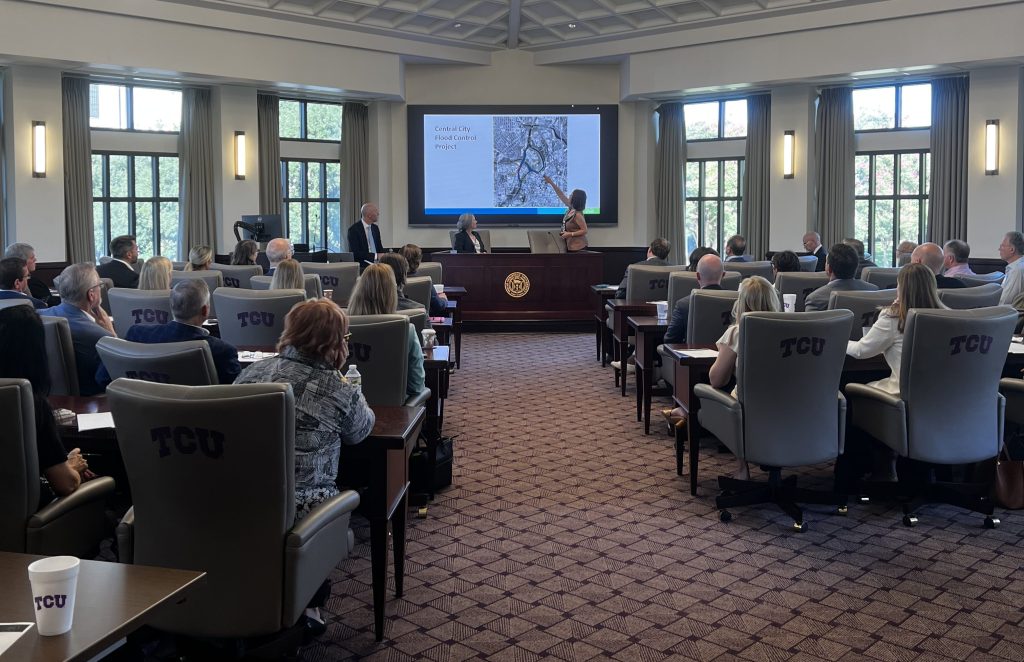
At the Fort Worth EDP’s most recent quarterly investor briefing, representatives from the City of Fort Worth and the Tarrant Regional Water District (TRWD) shared the latest on one of the most anticipated developments in the city’s history.
TRWD owns 36 of the roughly 100 acres currently available for development on the island, one of the largest holdings of any landowner. Once the levee work is complete, that inventory will grow to more than 78 acres, of which 54 is owned by TRWD, giving TRWD a substantial long-term stake in how the district takes shape. As the institution that has long stewarded the region’s water resources, TRWD brings that same long-term perspective to Panther Island. TRWD and other landowners are working in partnership with the City of Fort Worth, which is focused on land use and the regulatory framework rather than direct development. Change is already visible on the ground the recent closing of Coyote Drive-In, a local favorite since 2013, screened its final film on Sept. 7, with its land and existing pavilion set to become a three-acre park with portions of two new canals.
What’s Next For the Island
Next up for Panther Island is a refreshed rulebook. Known as a form-based code, it shapes how development looks and feels, from building heights to green space and walkability. First drafted in 2006 and updated several times since, the code’s latest revision draws on Panther Island Vision 2.0 and would expand open space to 15% of the island. In June 2026, the Fort Worth Urban Design Commission reviewed the proposed code updates, followed by City Council for consideration.
In parallel on the development side, TRWD has a Phase I, $40M project currently under the bidding process, and construction of the northern portion of the bypass channel is expected to begin early 2027. Together, these updates point to steady, deliberate progress on one of Fort Worth’s largest urban land opportunities, with clearer zoning direction expected by year’s end.
Together, these updates point to steady, deliberate progress on one of Fort Worth’s largest urban land opportunities. For a project long filed under ‘someday,’ the path forward is coming into view.