
April 10, 2026
Fort Worth is one of the fastest-growing cities in the country, and its economy is growing with it. To understand what that growth means for residents, the Fort Worth EDP Foundation tracks real gross domestic product (GDP) per capita—a measure of economic productivity per person that connects the region’s output to the everyday resources available to its residents.
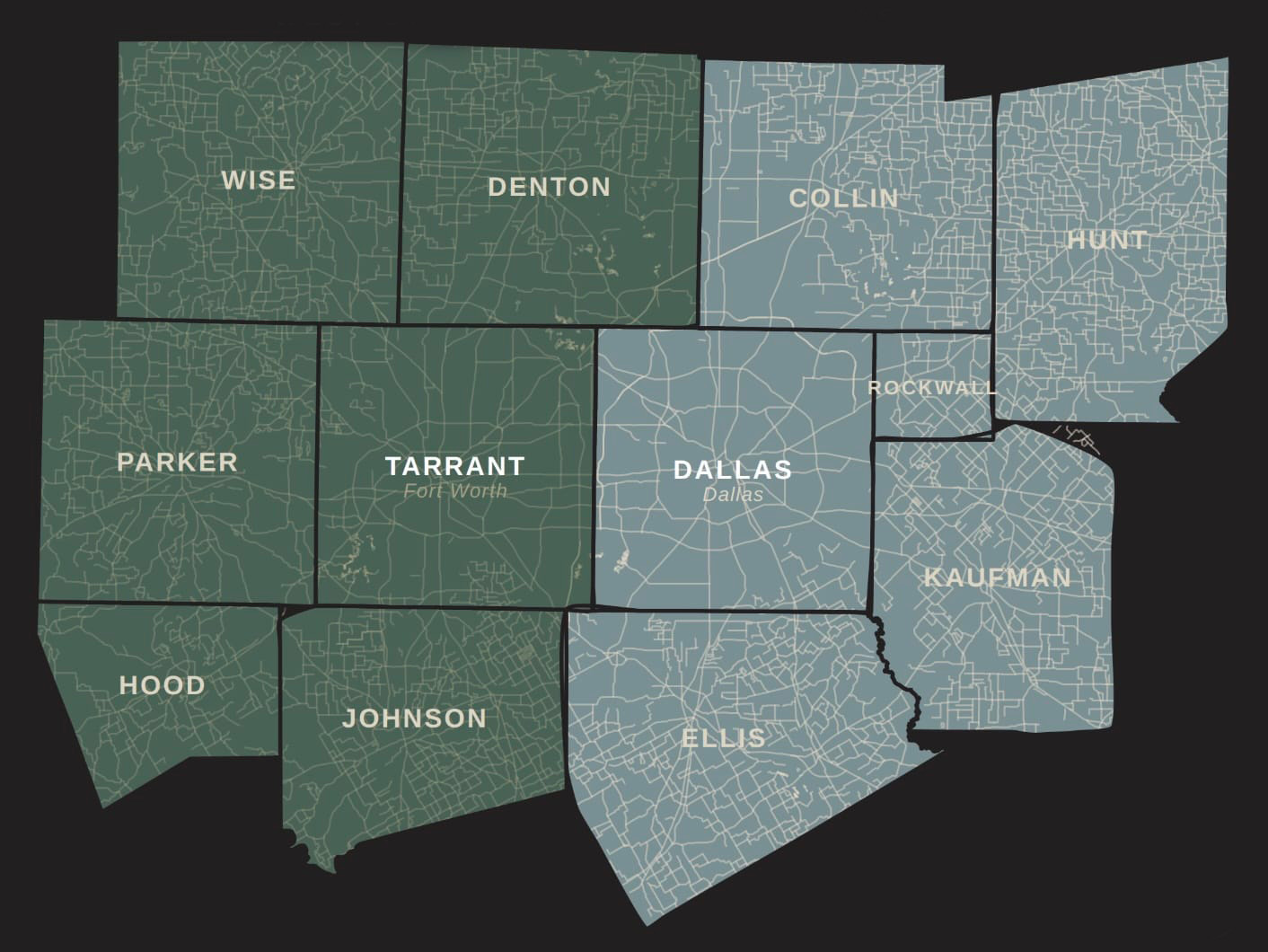
Looking at productivity per person helps capture how growth is shared, and distributed, across a region that in many ways operates as a single, connected economic area, rather than a collection of separate counties. To understand how this growth is experienced locally across DFW, we analyze productivity across several geographic levels. Specifically, we look at three areas, including DFW as a whole, its eastern and western regions, and Tarrant County, to understand the economic productivity trends in the area, as well as macroeconomic trends that shape our region, state, and county’s economic growth.
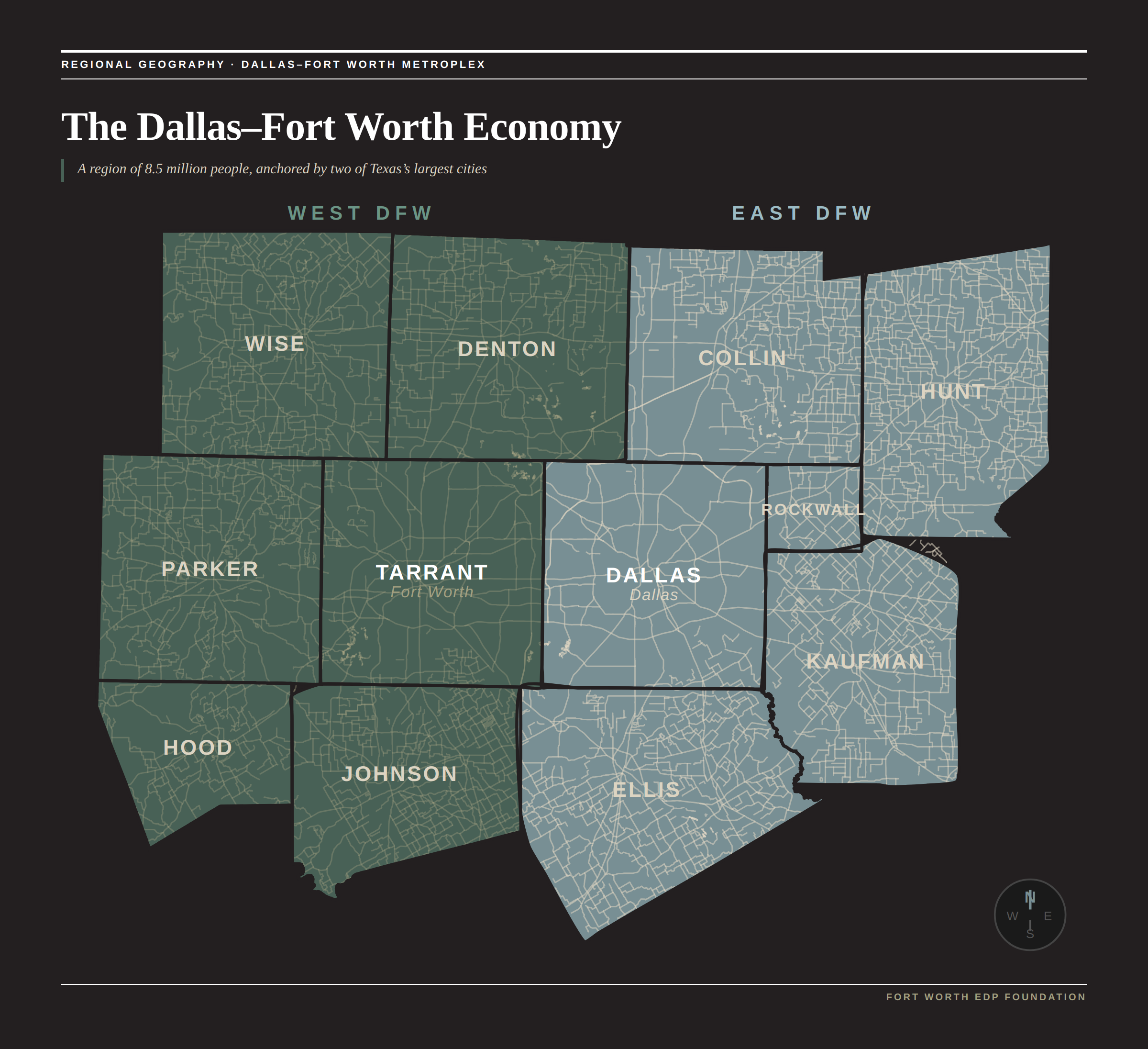
The recent release of 2024 GDP data shows encouraging growth in the Fort Worth region in terms of real GDP, as well as improvement in the GDP per capita against the national average. However, while Fort Worth’s economy is growing, productivity per person still lags behind neighboring areas, shaping the resources available to residents and motivating targeted economic development strategies focused on high-value job creation, strategic investment, and the flourishing of community life in Fort Worth.
2024 Real GDP in Dallas-Fort Worth
The U.S. Bureau of Economic Analysis (BEA) measures GDP, the total value of goods and services an economy produces, at the national, state, and county level, giving us a detailed picture of economic productivity across geographies over time. This data is released about one year after year-end; the 2024 figures, for example, became available in February 2026.
According to data released in February 2026, Tarrant County generated $139.9 billion in real GDP in 2024, ranking 4th in Texas out of 254 counties for total GDP.
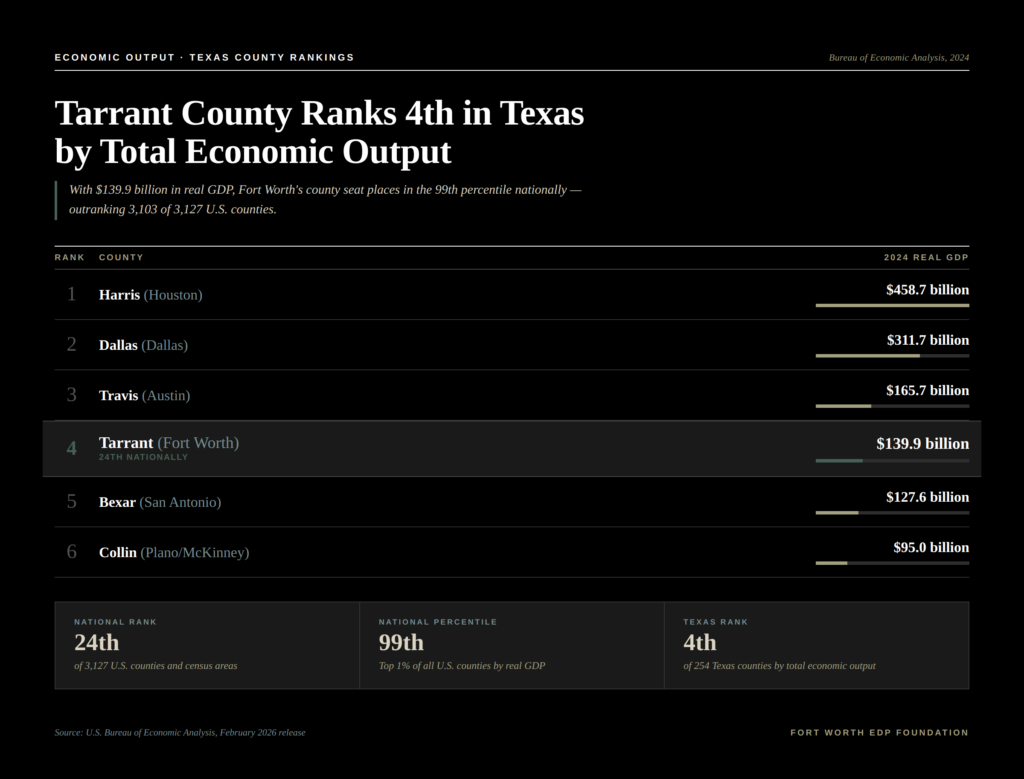
Nationally, Tarrant County ranks 24th of the 3,127 counties and census areas reported on in the BEA’s County GDP analysis. This puts Fort Worth’s county seat in the 99th percentile, or the top 1%, of all counties in the United States in terms of 2024 GDP. Fort Worth is not only in the top percentage of U.S. cities by population, but importantly, its county seat demonstrates comparable economic prowess.
In terms of GDP growth, Tarrant County’s $4.69 billion increase in real GDP in 2024 was the 4th greatest total increase of any county in Texas, following closely behind Harris ($16.74 billion increase), Collin ($4.91 billion increase), and Travis ($4.76 billion increase) counties, and outpacing the total growth of both Bexar and Dallas counties.
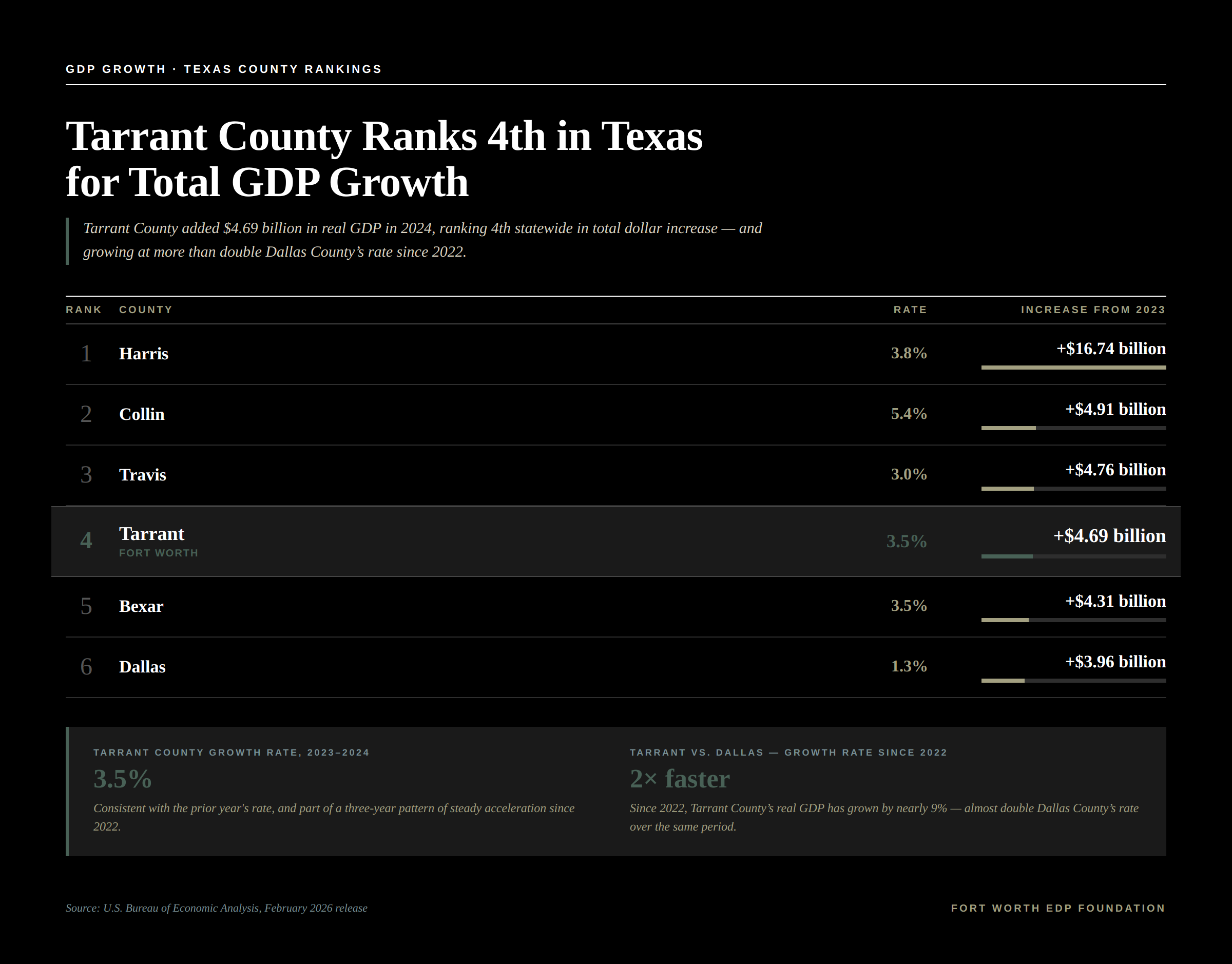
In terms of the rate of growth, Tarrant County’s total GDP increased by $4.69 billion from 2023 to 2024, representing a 3.5% increase. In the previous two releases, Tarrant County’s GDP increased by 3.7% in 2022 and then 5.3% in 2023. Since 2022, the real GDP of Tarrant County has grown by nearly 9%, almost doubling Dallas County’s rate of growth over the same period.
GDP per Capita Across Dallas-Fort Worth—Relating Productivity to Population
Raw GDP tells us how much an economy produces, but GDP per capita shows us how that output is distributed across the population. It’s a measure of productivity per person, and it’s where the picture of Fort Worth’s growth gets more nuanced.
In 2024, the average GDP per capita across the United States was $68,678.86. We use this figure to benchmark the Fort Worth area and DFW region’s GDP per person statistics to track year-to-year growth. Comparing local averages to national averages gives context to larger macroeconomic trends that inform economic growth in our area. In the same way, comparing the GDP data for the larger Dallas and Fort Worth regions contextualizes local growth trends that can be influenced by shared resources.
Based on 2024 BEA and U.S. Census Bureau data, Tarrant County’s GDP per capita was $62,707.95 per person and $54,809.47 per person in the larger Fort Worth region. Both sides of the metro increased in overall GDP, and the Fort Worth region improved in GDP per capita against the national average. The Fort Worth region’s margin narrowed to only 20.2% less than the national average, while the Dallas region’s GDP per capita was 36.8% above the national average.
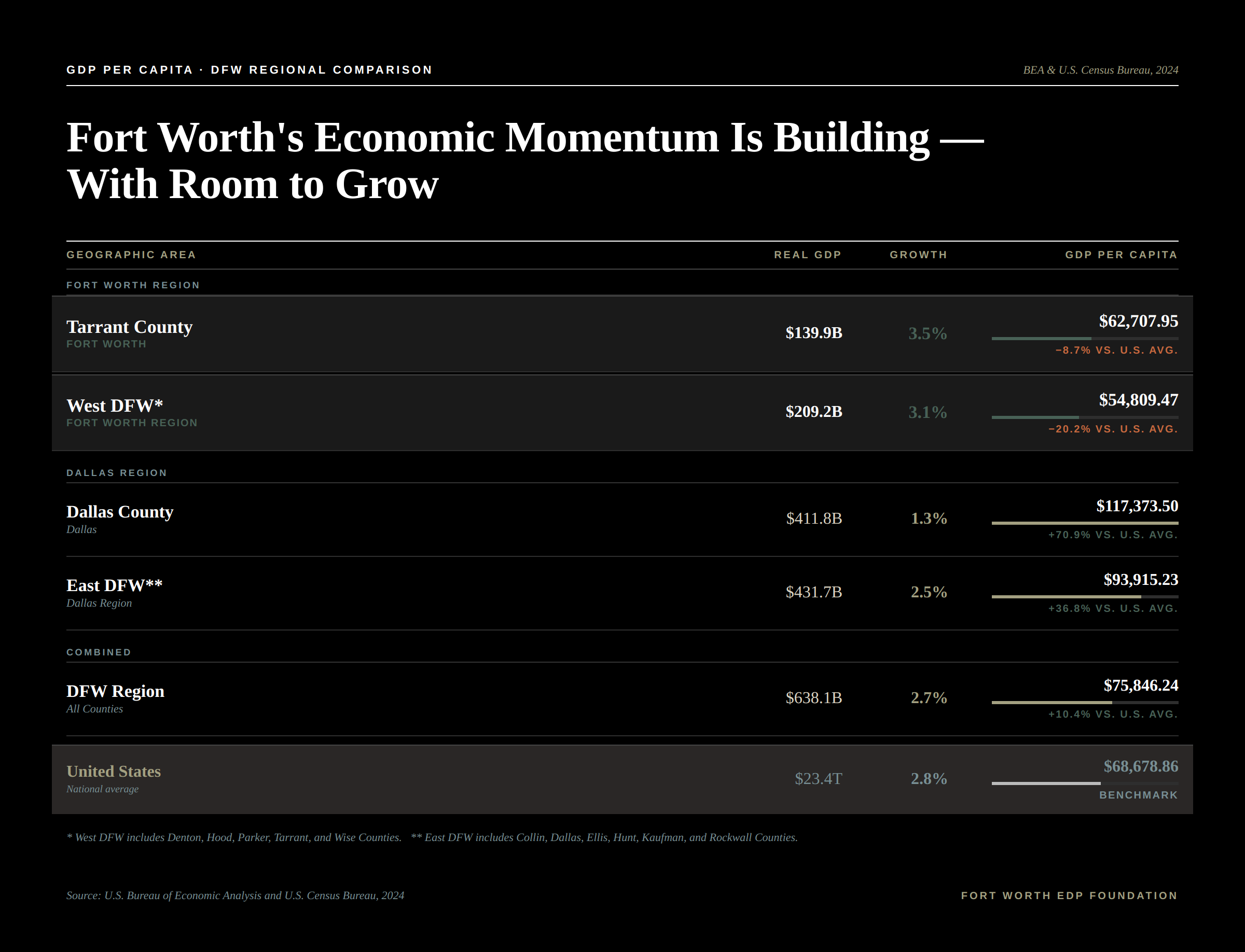
The chart illustrates some of the tensions in the data that motivate the work of the Fort Worth EDP Foundation. We hope that continued growth in the Fort Worth economy translates to a meaningful increase in the resources available to Fort Worth residents. These differences are not just statistical—they shape everyday access to opportunity across the region. For DFW area residents that crisscross the region for work and leisure, the difference in GDP per person might not be perceivable outside of a spreadsheet, but the data underscores the necessity of focused, strategic economic development efforts from business and community leaders in the Fort Worth region.
Why the Distribution of Productivity Across our Region Matters
We track GDP per capita to measure the resources that Fort Worth residents have access to and the assets that those resources support. The economic resources and dedication of Fort Worth residents support some of the things that make Fort Worth such a special place to live—supporting innovation, education, public spaces like parks and museums, and cultural landmarks across the city. And our taxes fund public assets like infrastructure, education, and civil services that make our city navigable, beautiful, and a great place to raise a family.
Comparing the productivity per person between counties and areas within the metroplex is a helpful tool to track growth and momentum because people who live in DFW understand the profound interconnectedness of the region. Different job centers, shopping amenities, museums, and entertainment venues are not restricted to just the residents within a particular zip code. For example, the Dallas Cowboys play in Arlington, but their devoted fans travel from Weatherford and Rockwall to go to the games.
So many of the region’s resources are shared across the region, anchored by two 1 million+ urban centers within 30 miles of each other. The data illustrates that while many public assets are shared across the metroplex, economic productivity is not so evenly distributed. And ultimately, economic productivity is not just about output—it’s about opportunity.
The resources and opportunities Fort Worth generates today will shape what’s available to the next generation. The parks, cultural institutions, thriving neighborhoods, and strong local economy that make this city special don’t happen by accident. They’re built on what the community creates together. The Fort Worth EDP Foundation exists to help guide that future with intention, bringing together civic, business, and community leaders to strengthen Fort Worth’s economy through data-driven solutions that preserve what makes this city great and expand opportunity for everyone who calls it home.
The Fort Worth EDP Foundation advances economic opportunity in the Fort Worth region through collaborative research and strategic initiatives that catalyze investment, generate jobs, and improve infrastructure, education, and quality of life.