
The question carries significant weight because talent risk is not merely a hiring challenge. It is a long-term operational consideration, one that shapes whether a company can sustain its workforce over time, develop leadership internally, and build the kind of organizational continuity that protects institutional knowledge and keeps replacement costs low.
Fort Worth’s answer to that question is structural. The region offers one of the deepest, most diversified labor markets in the country, anchored by institutional pipelines that produce and retain talent at rates that outperform most major metros. It does so within a cost environment that makes long-term employment sustainable for the company and the employee alike.
A Labor Market Built for Depth and Volume


North Texas offers access to more than 4 million workers across a multi-industry labor market that spans technology, advanced manufacturing, aerospace and defense, financial services, life sciences, logistics, and energy. More than 2.6 million of those workers live within a 45-minute commute of downtown Fort Worth. (Lightcast, 2025)
The significance of that number is not simply its size. It is the breadth of expertise it represents. Companies relocating to Fort Worth are not choosing between workforce depth and workforce diversity. The region provides both — a labor market where a defense contractor, a fintech firm, and a life sciences manufacturer can all recruit from established, sector-specific talent pools without competing for the same candidates.
Texas reinforces this advantage at the state level. In 2026, CNBC ranked Texas the No. 1 state in the nation for workforce, citing net domestic migration, educational attainment among working-age adults, career credential rates, concentration of STEM professionals, and the state’s right-to-work status.
For companies that need to hire at scale on day one, that labor market depth means faster ramp-up. For companies planning to grow over a five- or ten-year horizon, it means the talent will still be there when the next phase begins.
Why Talent Stays in Dallas/Fort Worth

Hiring is an expense. Retention is a return. The strongest markets are those where employees build careers and establish roots, and where retention is a function of the market itself as much as the company’s compensation structure.
In Fort Worth, retention is supported by institutional depth. The DFW metroplex is home to five Tier 1 research universities, with more than 72 percent of graduates from regional colleges and universities remaining in the DFW area to build their careers.
At TCU’s Neeley School of Business, that retention is even more pronounced. Approximately 70 percent of full-time MBA graduates remain in DFW after graduation. Among specialized master’s programs, the figure rises to roughly 85 percent. For executive and professional MBA graduates, retention approaches 90 percent. These are professionals who evaluate their options nationally and conclude that Fort Worth is where they can build the strongest career.
Retention at this level reflects a market where career opportunity, compensation, and quality of life are aligned closely enough that staying becomes the most rational choice. For companies building leadership teams, that continuity translates directly into institutional knowledge, organizational stability, and the kind of team cohesion that compounds over time.
A Talent Pipeline Designed for Continuity

Scale and retention address the present. The more forward-looking measure of a market’s talent viability is the system that produces the next generation of workers and leaders.
DFW’s universities and colleges produce more than 59,000 bachelor’s degrees and higher annually — a pipeline of early-career professionals entering the workforce each year with current training, relevant credentials, and established roots in the region. That output spans engineering, business, health sciences, technology, and the liberal arts — producing graduates equipped for the range of roles that a diversified economy requires.
The region’s investment in expanding that pipeline is deliberate. The Switchyard Innovation District, a major new initiative in downtown Fort Worth, is designed to unite academic research, industry application, and community development within a single integrated campus. Its purpose is to accelerate the connection between educational output and employer demand, ensuring that the talent entering the market is aligned with the industries that need it. Other key institutions in the area include the University of Texas at Arlington and Tarrant County College, each with more than 40,000 students enrolled.
Beyond higher education, the region’s workforce development system provides direct support for employers building or expanding teams. Workforce Solutions for Tarrant County operates as an extension of an employer’s human resources function, offering recruitment services, candidate screening, and employee training programs at no cost through its five workforce centers. For companies arriving in a new market and facing the operational challenge of hiring dozens or hundreds of employees simultaneously, that institutional support compresses what would otherwise be months of independent effort.
The Economics of Staying

Retention is shaped by more than career opportunity. It is also a function of whether employees can build a life, purchase a home, raise a family, and establish roots in the market where they work. The markets that retain talent most effectively are those where compensation goes further, where daily life is financially sustainable, and where the decision to stay is reinforced by the quality of the community itself.
Fort Worth’s cost environment is a significant factor in that equation. The metro’s cost of living runs 7 percent below the national average, with housing costs 22 percent lower. For an employee earning $120,000, that differential represents thousands of dollars in additional purchasing power each year, providing the margin that turns homeownership from aspirational to achievable.
This is the dual advantage that defines Fort Worth’s talent proposition. The cost structure benefits the company through competitive labor costs and lower operational expenses. It benefits the employee by providing a standard of living that makes a long-term commitment to the region a natural decision. Fort Worth has earned consistent recognition as one of the best places to live in Texas from outlets including Livability and Travel + Leisure — validation that the market’s appeal extends beyond the balance sheet.
The result, for employers, is a workforce that stays, teams that accumulate institutional knowledge, and organizations that retain the leaders they develop to build on that investment year over year.
The Evidence: Embraer
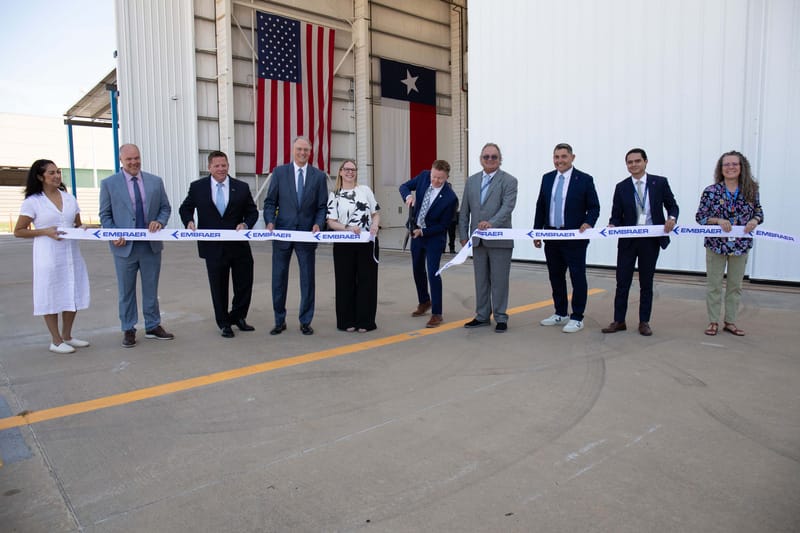
The most credible evidence of a market’s workforce capability comes when a company moves beyond the location decision and begins testing the talent ecosystem for itself. When Embraer announced its Fort Worth expansion in 2024, the global aerospace company committed to a significant new maintenance, repair and overhaul operation at Perot Field, bringing 250 new jobs to the region. Since then, operations have begun, construction of its primary facility has moved forward, and the company has started investing directly in the workforce that will support its growth.
Embraer credits “early engagement with Fort Worth EDP” as key to understanding the opportunities available across the region. That engagement connected the company with local education and workforce partners, including Tarrant County College, which Embraer has called “a key workforce engine for the region.” The company now supports scholarships for students in TCC’s Aviation Maintenance Technology program — strengthening the same pipeline of skilled technicians its growing Fort Worth operation will depend on.
It is a useful illustration of Fort Worth’s talent proposition in practice: a company can find the workforce it needs today while working alongside local institutions to strengthen the pipeline it will need tomorrow.
For organizations where workforce is the deciding factor in a location decision, Fort Worth offers a rare combination: the scale to hire now, the pipeline to grow later, and the cost environment to sustain both over time.
Key Takeaways
- Workforce at Scale: Access to more than 4 million regional workers, with 2.6 million within a 45-minute commute of downtown Fort Worth, spanning technology, advanced manufacturing, aerospace and defense, financial services, life sciences, logistics, and energy (Lightcast, 2025).
- Talent That Stays: More than 72 percent of regional graduates remain in DFW to build their careers. TCU Neeley retains roughly 70 percent of full-time MBA graduates and up to 90 percent of executive and professional MBA graduates (TCU Neeley School of Business).
- A Pipeline Built for Continuity: More than 59,000 bachelor’s degrees and higher each year from a region with five Tier 1 research universities, reinforced by the Switchyard Innovation District, the University of Texas at Arlington, and Tarrant County College (Dallas Chamber Higher-Education Review).
- Hiring Support From Day One: Workforce Solutions for Tarrant County offers no-cost recruitment, candidate screening, and training through five workforce centers, compressing months of hiring effort for relocating companies.
- Costs That Reinforce Retention: A cost of living 7 percent below the national average and housing costs 22 percent lower make a long-term commitment to Fort Worth a natural decision for employees (C2ER Cost of Living Index, Q1 2026).
- Proven in Practice: Embraer’s 250-job expansion at Perot Field shows the model at work: hiring from the region’s talent base today while investing in Tarrant County College’s pipeline for tomorrow.
Fort Worth Talent: The Executive Summary
Fort Worth offers the scale to hire now, the pipeline to grow later, and the cost environment to sustain both over time. It is a strong contender for any organization where workforce is the deciding factor in a location decision because of:
- Access to more than 4 million regional workers, with 2.6 million within a 45-minute commute of downtown Fort Worth (Lightcast, 2025)
- Location in Texas, ranked the No. 1 state for workforce (CNBC, 2026)
- More than 72 percent of regional graduates staying in DFW, and up to 90 percent retention among TCU Neeley executive and professional MBA graduates (TCU Neeley School of Business)
- More than 59,000 bachelor’s degrees and higher produced annually across a region with five Tier 1 research universities (Dallas-Fort Worth Regional Economic Development Guide, 2026)
- No-cost recruitment, screening, and training support through Workforce Solutions for Tarrant County’s five workforce centers
- A cost of living 7 percent below the national average and housing 22 percent lower, which supports long-term employee retention (C2ER Cost of Living Index, Q1 2026)
- Proven results: Embraer’s 250-job expansion at Perot Field, supported by early engagement with FWEDP and a direct investment in Tarrant County College’s aviation pipeline
Ready to explore what Fort Worth can offer your organization? Contact the Fort Worth Economic Development Partnership to start the conversation.
Frequently Asked Questions About Fort Worth’s Workforce
How Large Is the Fort Worth Labor Market?
Fort Worth companies can recruit from more than 4 million workers across North Texas, and more than 2.6 million of them live within a 45-minute commute of downtown (Lightcast, 2025). The labor market spans technology, advanced manufacturing, aerospace and defense, financial services, life sciences, logistics, and energy. Companies in different sectors can recruit from established, industry-specific talent pools without competing for the same candidates.
Do College Graduates Stay in the Area?
Yes. More than 72 percent of graduates from regional colleges and universities stay in DFW to build their careers. Retention is even higher at TCU’s Neeley School of Business: roughly 70 percent of full-time MBA graduates, 85 percent of specialized master’s graduates, and nearly 90 percent of executive and professional MBA graduates stay in the region.
How Is Fort Worth Expanding Its Talent Pipeline?
DFW’s universities and colleges produce more than 59,000 bachelor’s degrees and higher every year. Fort Worth is adding to that output through the Switchyard Innovation District, a downtown initiative that brings academic research, industry application, and community development together on one campus. The University of Texas at Arlington and Tarrant County College each enroll more than 40,000 students and supply talent across engineering, business, health sciences, technology, and the skilled trades.
What Hiring Support Is Available to Companies Relocating to Fort Worth?
Workforce Solutions for Tarrant County works as an extension of an employer’s HR function. Through five workforce centers, it provides recruitment services, candidate screening, and employee training programs at no cost. The Fort Worth Economic Development Partnership also connects companies with local education and workforce partners early in the process, which can shorten the time it takes to staff a new operation.
How Does Fort Worth’s Cost of Living Affect Employee Retention?
Fort Worth’s cost of living runs 7 percent below the national average, and housing costs are 22 percent lower. For employees, that means higher purchasing power and a realistic path to homeownership. For employers, it supports competitive labor costs and a workforce more likely to stay for the long term.
Which Companies Have Built Their Workforce in Fort Worth?
In 2024, Embraer announced a new maintenance, repair and overhaul operation at Perot Field that will bring 250 jobs to the region. The company credits early engagement with the Fort Worth Economic Development Partnership with connecting it to local education and workforce partners. It now funds scholarships in Tarrant County College’s Aviation Maintenance Technology program to strengthen the pipeline of skilled technicians its Fort Worth operation will depend on.